A new study using data from the UK National Registry of Rare Kidney Diseases (RaDaR) has been published in Nephrology Dialysis Transplantation.
The paper, Association of UACR and UPCR with kidney failure: analysis of observational data in patients with rare kidney diseases, examines how different urinary protein measurements relate to kidney failure risk in patients with rare kidney diseases.
ACR is widely used in clinical guidelines, trials and risk prediction models in chronic kidney disease, while PCR has historically been more commonly used in studies and treatment pathways for rare glomerular diseases. This difference can make it difficult to compare datasets or interpret research where only one measurement is available.
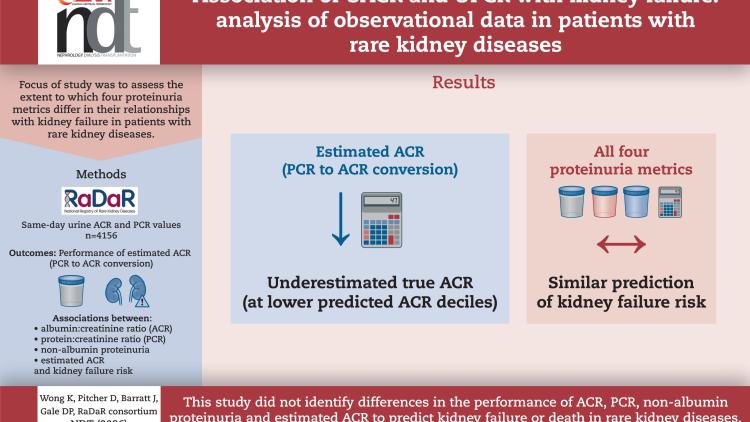
Using same-day paired ACR and PCR measurements recorded within RaDaR, researchers examined how several proteinuria measures - including ACR, PCR, non-albumin proteinuria and estimated ACR derived from PCR - relate to the risk of kidney failure or death.
Across the cohort, 717 patients (17%) experienced kidney failure or death during follow-up. The findings indicate that different proteinuria measurements used in clinical practice and research perform comparably in predicting kidney failure risk in rare kidney disease cohorts.
Estimated ACR calculated from PCR also showed similar predictive performance to measured ACR. This suggests that estimated ACR derived from PCR may be used in observational studies or clinical trials where only PCR measurements are available, helping to broaden the range of datasets that can be analysed.
By enabling access to large, well-characterised cohorts of patients with rare kidney diseases across the UK, RaDaR provides a platform for analyses that would otherwise be difficult to undertake. Studies such as this demonstrate how registry data can be used to address methodological questions relevant to both clinical research and the interpretation of existing datasets.
The study was led by Katie Wong with collaborators David Pitcher, Jonathan Barratt and Daniel Gale on behalf of the RaDaR Consortium.