How can rare disease data lead to new treatments?
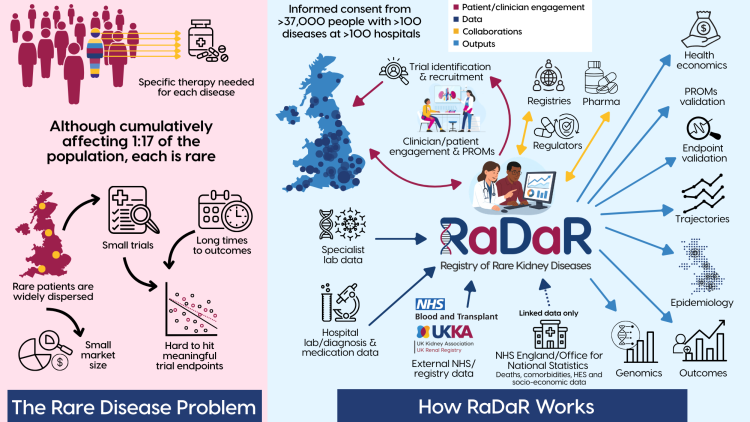
A paper featured in the May issue of Nephrology Dialysis Transplantation (NDT) explores how RaDaR, the UK National Registry of Rare Kidney Diseases, is helping bridge the gap between rare disease data, clinical trials and treatment development.
The article, From Data to Drug: The Translational Impact of RaDaR, the UK National Registry of Rare Kidney Diseases, highlights the growing role of national registry data in supporting translational research across rare kidney diseases.
Although individual rare kidney diseases affect relatively small numbers of patients, collectively they place a major burden on patients, families and healthcare systems. The paper explores how long-term national data collected through RaDaR can help researchers better understand disease progression, support clinical trial recruitment and generate evidence to support the development and evaluation of new therapies.
The article also outlines the wider role of RaDaR in supporting epidemiological research, genomics, patient-reported outcomes and national and international research collaborations across a wide range of rare kidney conditions.
RaDaR currently includes more than 37,000 participants from over 100 sites across the UK, making it one of the largest rare kidney disease registries of its kind.
The feature in Nephrology Dialysis Transplantation reflects the increasing importance of registry-led research in rare kidney diseases and the value of large-scale longitudinal data in helping translate research into tangible improvements in patient care.
Read the full article in Nephrology Dialysis Transplantation:
https://academic.oup.com/ndt/article/41/5/839/8301228