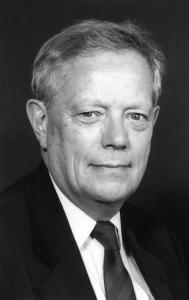
Daniel Gwyn Williams (always known as Gwyn) was an academic clinical nephrologist and laboratory investigator who in later career gained great respect for his skilful leadership in medical school administration, and in national nephrology.
Gwyn Williams was born in 1940 in Swansea. His father was a church minister, his mother a housewife. He had two siblings - an older sister and a younger brother.
Gwyn was educated at Cardiff Grammar School before entering the Welsh National School of Medicine in Cardiff to read medicine in 1958. He was the outstanding medical student of his year, winning the Seager Medals in Medicine, Pathology, and Surgery.
He joined the Academic Medical Unit where he was influenced towards a clinical academic career by the Professor of Medicine Harold Scarborough an inspiring physician who (unusually for that era ) had a PhD in Biochemistry and was the co-author of Bell, Davidson & Scarborough (BDS) a widely read undergraduate textbook of physiology and biochemistry.
Cardiff had recently developed an artificial kidney unit for the treatment of acute renal failure which aroused Gwyn’s interest in nephrology. He then moved to Oxford and after further clinical training became research assistant to Sidney Truelove. He then worked as senior registrar in Oxford with John Ledingham which confirmed his enthusiasm for renal disease and in 1971 he moved to the Royal Postgraduate Medical School at Hammersmith Hospital to work with Keith Peters, whom he had known in Cardiff. With Peters and the immunologist Peter Lachmann, Gwyn produced over the next three years a body of important work defining the role of complement in human glomerulonephritis. In particular he worked on what has later become known as C3 nephropathy - defining the nature of C3 nephritic factor as an autoantibody which destabilises the physiological control mechanisms of the complement alternative pathway. This work which led to his MD awarded in 1974 by the University of Wales. His time at Hammersmith also included a period of study in Paris on an INSERM Scholarship at the Hôpital Tenon, working closely with Olivier Kourilsky who became a life-long friend.
In 1967 Gwyn married Angie, a nurse, whom he had met at the Radcliffe Infirmary in Oxford; they went on to have four daughters.
In 1974 he was appointed senior lecturer and honorary consultant nephrologist at Guy’s Hospital where he was to spend the rest of his career. At Guy’s Stewart Cameron and Chisholm Ogg had built a large and busy renal unit with an international reputation for clinical care, teaching and research. Gwyn entered vigorously into the clinical work, at the same time continuing his research interests in the mechanisms of injury in human and experimental nephritis.
Gwyn’s other skills soon became apparent. He had great management and leadership aptitude, and he held a series of management positions with increasing responsibility at Guy’s before becoming Clinical Dean of the United Medical and Dental Schools of Guy’s and St. Thomas’s (UMDS) in 1996. A patient listener, his management style was based on understated consensus building, supported by apparently inexhaustible diplomatic negotiating skills. These were much needed when in 1998 he became Dean of the newly amalgamated Guy’s, Kings, St Thomas’s (GKT) Medical School. While this amalgamation was a logical consequence of the need to reduce and strengthen the number of medical schools in London, GKT began life uncertainly, and its very existence was upsetting for substantial groups of senior staff with career long commitment to one or other of the institutions. Gwyn somehow ensured the birth and successful early life of GKT with much listening and great patience. He skilfully negotiated a consensus plan acceptable to both NHS and university partners, and then achieved the harder part - working tirelessly and apparently effortlessly to convince senior staff to accept the proposals, including many who had been his longstanding colleagues.
He also contributed much to the national medical scene – notably as Assistant Registrar at the Royal College of Physicians (1981-1987), honorary Treasurer of the National Kidney Research Fund (1986-1995) and Secretary (1982-1986) and then President (1998-2001) of the Renal Association.
Gwyn retired in 2004, leaving behind an array of patients, nephrologists and other medical colleagues who were grateful to have known him and worked with him.
In retirement he continued to live in Kent. A gifted pianist and organist, he studied for an Open University degree in music. Gwyn also travelled widely, pursuing interests in Ancient Greece and Russia, and was a keen photographer and follower of the arts. He was President of the Society for the History of Medicine in Wales 2014-15. He combined all of this with extensive grandpa duties, which he carried out with great enthusiasm and love.
Gwyn died peacefully aged 86 years surrounded by family. He is survived by his wife, their four daughters - all of whom followed their father into the public sector, either in health or education – and six grandchildren, the oldest of whom is a clinical oncology nurse specialist.