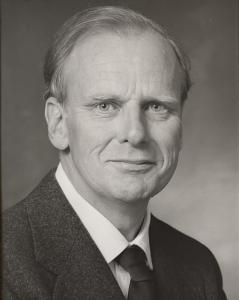
Michael Dunnill’s long life was a large mosaic of both connected and separate themes. His influence on medicine was probably underappreciated because he did not seek the spotlight, titles or commanding roles. Scholarly study of morbid anatomy was at the centre of his professional life but he felt a call to work for the improvement of the Oxford medical school which he compared unfavourably with his alma mater in Bristol.
He was born and brought up in that city the son of Florence and Arthur Simpson Dunnill. He attended a peculiar local preparatory school free of charge because his grandmother was the matron. He was eleven years old when war was declared and recalled seeing a Heinkel III bomber undertaking a low-level daylight run over the neighbourhood. It destroyed the local doctor’s house. The school was evacuated to St Briavel’s Castle in Gloucestershire in December 1940. He had to make his way from the train station up a long hill, a challenge for a child with asthma, a disease he went on to study. On one occasion the effort in the cold brought on a serious asthma attack which he was lucky to survive. Two years later he won a scholarship to Bristol Grammar school where he thrived, played First XI cricket and met Tom Graveney who later played for England.
He won a scholarship to Bristol University to read Medicine in 1946 and graduated in 1951 winning the Surgery gold medal. He did his pre-registration jobs in Bristol where he met Hilda, a midwife and they married soon after. National service in the RAMC took him to the British Army base in the Suez area of Egypt. He was lucky to survive an attack on the ambulance in which he was driving. He did however have the opportunity of working in the hospital lab where he developed his interest in pathology.
He returned to Bristol in 1954 to work as a junior clinical pathologist. His next post was as a lowly Graduate Assistant in the Radcliffe Infirmary department of pathology in Oxford. He was promoted to Lecturer in Pathology which was senior registrar grade. He worked on asthma demonstrating the importance of inflammation as opposed to bronchospasm in fatal cases. These findings probably changed treatment which came to include corticosteroids and antibiotics as well as the bronchodilators. He was appointed to a consultant post which was good for Oxford as the department was dysfunctional. Before he took up the post he was invited to spend two years at the cardiopulmonary laboratory led by Prof Andre Cournand and Dickinson Richards (together awarded the Nobel Prize in 1956) in Columbia University New York at the Bellevue Hospital. Cournand was so impressed that he offered Dunnill a permanent position which he bravely and honourably declined. He returned to the consultant post in Oxford which had been held for him. Back in Oxford he caught the eye of the Regius Professor of Medicine, Sir George Pickering, who engaged Michael in his efforts to improve the clinical course including pathology and increase the number of students then set at thirty per year. Michael had contacts in Cambridge so he drafted a letter to them urging them to direct their best graduates to Oxford rather than London for clinical training. They responded positively but Michael got no credit. He also assisted Pickering in the planning for the new medical school in Nottingham. His encouragement of co-operation between the pre-clinical and clinical schools and belief in a balanced curriculum for clinical medical students were respected by senior academics and so the changes were largely accepted. In 1966 he was invited to be the Director of Clinical Studies in Oxford overseeing the course and taking pastoral responsibility for the students not all of whom were well-behaved or committed. After six years he was asked to do another term by the new Regius Professor of Medicine Richard Doll but declined, wishing to return to his work on lung pathology in particular developing expertise in quantitative measurement of histological changes. The Regius was very disappointed but later forgave him.
In the late 1960s a new medical specialty, nephrology, was emerging and there was a need for a pathologist to interpret the appearances of cortical renal biopsy specimens. Before biopsies nephrologists had relied on diagnoses that were inferred from the history, the clinical and urine examination. Pathologists could describe the actual renal lesions. Dunnill was approached by the newly appointed Dr John Ledingham who had an eclectic array of clinical interests which included renal disease. He asked Michael whether he would report the renal biopsies. Michael agreed but he would have told him that he had no expertise. Indeed, there were few, if any, specialist renal pathologists in the United Kingdom. Michael told me (CW) that he had taught himself and, as a discipline, decided to write a book on the subject – Pathological basis of renal disease. In 1973 Peter Morris an Australian transplant surgeon and immunologist was appointed to the Nuffield Chair of Surgery vacated by the chest surgeon Professor Philip Alison for whom Michael had provided a pathology service. He offered to do the same for the new professor. Again, he taught himself about the pathology of kidney transplantation.
Morris prepared the many young haemodialysis patients for transplantation but wanted to avoid any post-transplant infections of the failed native kidneys. A large number of bilateral nephrectomies were performed which Dunnill examined. To his amazement he found that the kidneys that had failed for a variety of reasons, had developed, as they degenerated, cysts and adenomas. He described this new kidney disease as “acquired cystic disease”. A clinical observation by the then nephrology registrar Peter Ratcliffe (later FRCP,FRS and Nobel laureate) that some of these patients had normal haemoglobin concentrations was attributed to erythropoietin production by the adenomas. This proved to be true. Peter went on to discover the hypoxia sensing mechanism in the kidneys which controls erythropoietin synthesis, work for which he was awarded the Nobel prize for Physiology and Medicine in 2019. So, Michael worked with, not one, but two Nobel laureates, one in the field of lung disease and the other kidneys.
In recognition of his scientific work in lung disease and his commitment to medical education Michael was in 1967, invited to be a fellow of Merton College. Oxford. He enjoyed the vigorous talk of the SCR and the famous wine cellar. He later became the Wine Steward and also served the College as Sub Warden. In 1995 he was elected an Emeritus Fellow. He was a member of the Athenaeum and the MCC. In retirement, on Lords Test match days he could be seen on Oxford Station appropriately attired in a light suit wearing his MCC tie (nicknamed the ‘egg and bacon’) and a Panama hat. After Hilda‘s death he continued living in the family home in Hampton Poyle surrounded by the garden he had created, his collection of books in particular Victorian novels of Trollope, the Times and the Spectator. He became a keen writer of medical history, producing The Plato of Praed Street: a life of Almroth Wright and, William Budd: Bristol's greatest physician. He had to give up fishing but kept up his long interest in music. He kept himself dextrous by doing tapestries and avoided loneliness by receiving visitors who were offered coffee in the morning or at a dusk a glass of white burgundy. He wanted to know all the latest gossip and pronounced on matters medical and Oxfordian. The Bodleian library has a delightful interview of Michael Dunnill by Dr Derek Hockaday in the Series Recollecting Oxford Medicine. Sadly, he developed myeloma which was successfully treated but very arduous to bear. He also developed carcinoma of the prostate which was similarly contained and later heart failure but his brain seemed perfectly protected. He and Hilda had two sons, Philip an investment banker who predeceased him and Giles a consultant dermatologist in Bristol who shares his father‘s interest in clinical pathology. Giles spoke movingly at the funeral in Saint Mary the Virgin Church Hampton Poyle where Michael had been Church Warden. His four grandchildren attended and one read the lesson and another his favourite poem Up-hill by Christina Rossetti about life’s struggle but a comfortable end.
Christopher Winearls FRCP who acknowledges the help of:
Dr Derek Hockaday FRCP
Dr Giles Dunnill FRCP
Merton College, Oxford