Members of the National Registry of Rare Kidney Diseases (RaDaR) team have travelled to Washington DC to present Alport syndrome data at the headquarters of the US Food and Drug Administration (FDA).
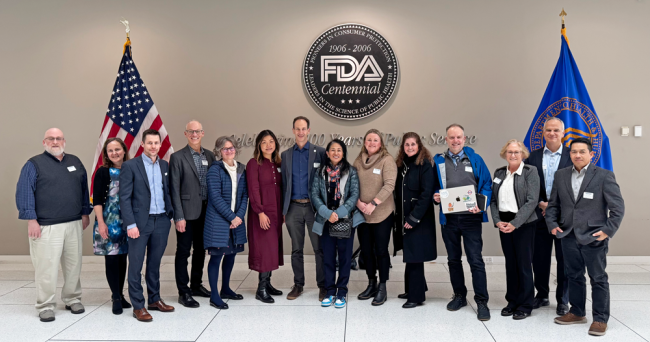
RaDaR Biostatistician David Pitcher, RaDaR Clinical Research Fellow Dr Katie Wong and RaDaR Director Prof Daniel Gale, were invited to take part in high-level discussions focused on how clinical trials for Alport syndrome could be accelerated through the approval of surrogate endpoints. The visit was convened and funded by the Alport Syndrome Foundation (ASF).
Alport syndrome is a rare inherited kidney condition for which there are currently no specific FDA-approved drug treatments.
“This is a first step towards hopefully getting some treatments developed and approved in the future that can slow the progression of the disease to the point where patients don't require dialysis or transplantation, or significantly delay initiation”, said David.
ASSENT and the role of global data
The meeting centred on the work of ASSENT – the Alport Syndrome Surrogate Endpoint NeTwork, a global, volunteer-led initiative established by the Alport Syndrome Foundation. The ASSENT Work Group brings together patients, caregivers, nephrologists, academics, biostatisticians, dataset holders and regulators.
By collecting and analysing high-quality Alport syndrome data from around the world, ASSENT aims to establish which measurable biological factors are reasonably likely to predict progression to kidney failure. If accepted by regulators, these factors could be used as surrogate endpoints in clinical trials, helping to speed up the evaluation of new treatments.
Following the meeting, the Alport Syndrome Foundation said:
“Thank you to the FDA for an excellent five-hour meeting to discuss and align on the roadmap for ASSENT with the Cardiology and Renal Division Team and expert biostatisticians. Much gratitude as well to the team of expert clinicians, researchers and biostatisticians that are volunteering their time to move this work forward. The work advances with strategy, dedication and hope.”
RaDaR’s contribution to international progress
Professor Daniel Gale, Director of RaDaR, said:
“Presentations, including those from David and Katie from the RaDaR team, went down very well, and there was a strong sense of optimism that this work could help to bring effective treatments closer for people living with this rare disease. This is a good example of how RaDaR works internationally, alongside patient organisations and researchers, to help drive progress.”
What this could mean for patients
The ability to use validated surrogate endpoints in trials has the potential to significantly shorten the time it takes for new treatments to reach patients. For people living with Alport syndrome, this could mean earlier access to therapies that delay kidney failure and reduce the need for dialysis or transplantation.
RaDaR continues to play a central role in supporting rare disease research through the provision of robust, internationally relevant data to clinicians, regulators and industry.