Recognising and responding to AKI in primary care

AKI is identified using internationally agreed criteria based on changes in serum creatinine relative to an individual’s baseline and, in some settings, urine output. AKI is commonly identified through laboratory reports that flag significant changes in kidney function (“AKI warning stage” results).

These alerts are designed to prompt clinical review but cannot incorporate clinical context.

Interpretation therefore requires consideration of:

  • why the blood test was taken (routine monitoring versus acute illness),
  • whether the patient is currently unwell,
  • baseline kidney function and recent trends,
  • the patient’s overall physiological status (including fluid status and evidence of physiological deterioration, for example a rising NEWS2 score),
  • whether the change may reflect acute deterioration or progression of known chronic kidney disease, and
  • medicines that may contribute to hypoperfusion, hyperkalaemia, or drug accumulation.

info icon

Interpreting AKI warning stage results: avoiding false positives and negatives

Not all rises in serum creatinine represent AKI. In people with established CKD, modest changes may reflect biological variation, intercurrent illness, or progression of underlying disease rather than acute injury. Distinguishing AKI from CKD progression relies on clinical context, trends over time, and the reason testing was undertaken.

Not all AKI warning stage test results represent true AKI. Apparent or “pseudo-AKI” may arise where changes in serum creatinine do not reflect acute deterioration in kidney function.

Situations where an AKI warning stage result should be interpreted with particular caution include:

  • People with established chronic kidney disease, where baseline creatinine values used by the detection algorithm may not reflect the individual’s true stable baseline.
  • Long intervals between baseline and current creatinine measurements, particularly where previous values are more than 6–12 months old.
  • Use of medicines such as trimethoprim, which can increase serum creatinine by inhibiting tubular secretion without reducing glomerular filtration.
  • Physiological changes around pregnancy and the post-partum period, where creatinine may rise toward pre-pregnancy values.

There is also a need to consider the possibility of a false negative alert. Patients with a history of recurrent AKI may not always trigger an AKI alert if their median creatinine (days -7 to -365) is elevated by previous episodes of AKI, leading to a spuriously high baseline creatinine being generated within the detection algorithm.


In clinically stable patients where the diagnosis of AKI is uncertain, repeat testing within 48–72 hours can help determine whether kidney function is changing dynamically (supporting AKI) or remains stable (suggesting chronic disease or biological variation). AKI warning stage results should always be interpreted alongside clinical assessment and trends over time, rather than in isolation. NICE CKS provides pragmatic advice on responding to AKI warning results in primary care contexts.

Urinalysis should be performed wherever possible as part of the initial assessment. The presence of haematuria, proteinuria, or active urinary sediment may suggest intrinsic kidney disease and should prompt earlier review or specialist advice. Urinalysis is a screening tool to support clinical assessment and is not a substitute for interpreting kidney function trends in clinical context.

An improving creatinine does not necessarily indicate full recovery or resolution of risk. Even low-stage AKI is associated with increased short- and long-term adverse outcomes, particularly in older adults and those with comorbidity. Clinical vigilance should therefore be maintained after an AKI warning stage result, even where kidney function appears to have partially or fully normalised.

Responsibility for reviewing AKI warning stage results

Every AKI warning stage test result received by a primary care service should be reviewed and considered by a responsible clinician. This applies regardless of who ordered the test, whether the result was generated in hours or out of hours, or whether the patient has already been discharged from hospital. Primary care teams should have clear internal processes to ensure that AKI warning stage results are not missed and that responsibility for review, follow-up testing, and patient contact is explicit.

warning icon

Clinical responsibility and safe handling of AKI warning stage results

Clear allocation of responsibility is essential to prevent missed or delayed responses to AKI warning stage results and to support patient safety across transitions of care.

The following principles should be applied:

  • The clinician who requests a blood test remains responsible for reviewing the result, taking appropriate action, and communicating outcomes to the patient and their general practice, even if the patient has been discharged.
  • Every AKI warning stage test result received by a primary care service should be reviewed and, where necessary, acted upon by a responsible clinician, regardless of who ordered the test or when it was generated.
  • Communication and follow-up should take account of patient autonomy and individual needs. Reasonable adjustments should be made for people with cognitive impairment, learning disability, or mental health conditions, and families, carers, or care coordinators should be involved where appropriate.

Robust internal systems are required to support this, including clear out-of-hours arrangements, reliable handover processes, and clear documentation of actions taken.

How quickly should an AKI warning stage result be reviewed?

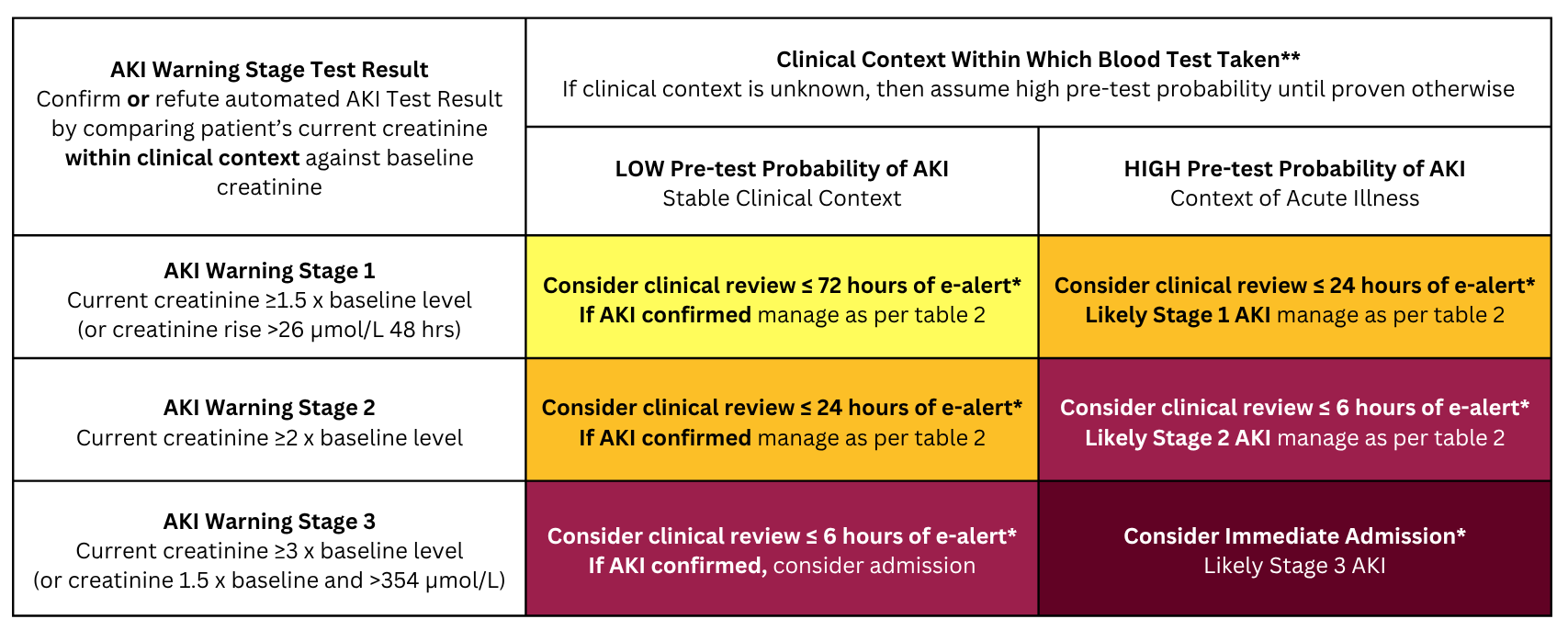
Table 1 provides guidance on the urgency of clinical review following an AKI warning stage test result. It is intended to support timely assessment while recognising that clinical judgement remains essential.

Table 1: Recommended response times to AKI warning stage test results for adults in primary care
*** UK Kidney Association Clinical Practice Guidelines (2023) recommend emergency assessment and treatment of severe hyperkalaemia (K+≥6.5mmol/l)
The table is a guide to support an initial response to an AKI Warning Stage Test Result, but clinical judgement must take precedence.
The table does not apply to children and young people (<18 years) or patients receiving end of life care.

* AKI Risk Factors/Clinical Features Prompting Earlier Review

  • Poor oral intake/urine output
  • Evidence of hyperkalaemia, especially if moderate(K+ 6.0-6.4) or severe (K+ ≥ 6.5)***
  • Known history of CKD stages 4 & 5 or history of kidney transplant
  • Deficient Immunity
  • Frail with co-morbidities (CKD, diabetes, heart failure, liver disease, neurological or cognitive impairment)
  • Past history of AKI
  • Suspected intrinsic kidney disease
  • Suspected urinary tract obstruction

** Clinical Context

Why was the blood test taken?

  • Routine chronic disease monitoring
  • Drug monitoring
  • Assessment of acute illness

Creatinine rise within stable clinical context may reflect unstable CKD instead of AKI, especially if longer time period between current and baseline creatinine.

NICE quality standards (QS 76) set expectations for timely response to higher-stage AKI alerts (including within 6 hours for adults with an AKI warning stage 2 result who are acutely ill or admitted to hospital, and within 24 hours if clinically stable).

Structured assessment and immediate decision-making

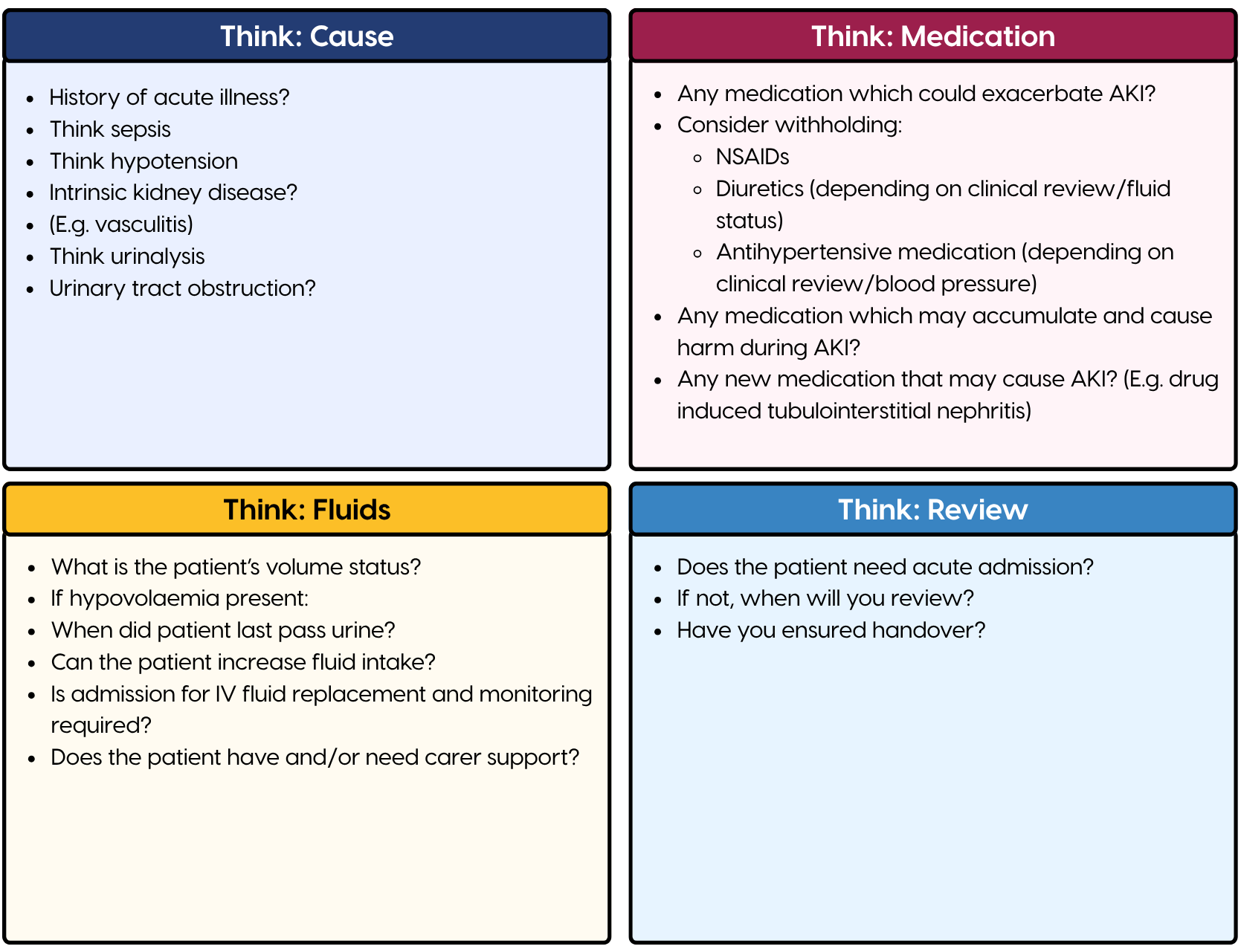
Table 2 summarises key clinical considerations when assessing a patient with suspected or confirmed AKI. It supports a structured approach to decision-making, including identification of features that should prompt earlier review, urgent assessment, or hospital admission.

Table 2: Recognising and responding to AKI for adults in primary care

When responding to an AKI warning stage test result, clinicians should consider:

  • evidence of ongoing acute illness or physiological deterioration,
  • significant electrolyte disturbance (particularly hyperkalaemia),
  • reduced urine output,
  • advanced CKD or kidney transplantation,
  • membership of a higher-risk group, including:
    • older age,
    • diabetes,
    • heart failure,
    • liver disease,
    • frailty or multimorbidity,
    • previous episodes of AKI, or
    • polypharmacy,
  • features suggesting intrinsic or obstructive kidney disease.

If AKI is suspected or confirmed, management should align with NICE NG148, with escalation where required.

Sepsis

If sepsis is suspected on clinical assessment, urgent hospital admission is required irrespective of AKI warning stage or creatinine change. In this context, AKI should be regarded as a marker of severe acute illness rather than a condition to be managed in isolation.

Heart failure

People with chronic heart failure are at increased risk of AKI, particularly during intercurrent illness or changes in volume status. Interpretation of AKI warning stage results in this context requires careful clinical judgement.

Rises in serum creatinine may reflect:

  • True AKI due to hypovolaemia, sepsis, or hypotension, or
  • Haemodynamic changes related to diuretic therapy or optimisation of prognostic medicines.

Assessment should focus on the patient’s overall clinical status and volume state, including whether they are fluid overloaded, euvolaemic, or hypovolaemic. An important principle is to treat the patient rather than the blood test. Inappropriately stopping diuretics or renin–angiotensin–aldosterone system (RAAS) inhibitors may precipitate decompensated heart failure or worsen kidney congestion.

Where uncertainty exists, or where AKI is accompanied by significant electrolyte disturbance or clinical deterioration, early discussion with specialist heart failure or renal services is appropriate.

Considering urinary tract obstruction

Post-renal causes account for a significant minority of AKI episodes and should be actively considered during assessment. Features suggesting urinary tract obstruction include lower urinary tract symptoms, reduced or absent urine output, a history of prostatic disease, pelvic malignancy, or neurogenic bladder.

Where obstruction is suspected, urgent assessment is required. Failure to recognise and relieve obstruction can lead to rapid deterioration in kidney function and potentially irreversible damage. Clear safety-netting is essential. Patients should be advised when and how to seek urgent review if symptoms worsen, oral intake declines, urine output falls, or new symptoms develop. Responsibility for follow-up and repeat testing should be explicit, including who will review results and how the patient will be contacted.

info icon
Safety-netting and assessment

Assessment in primary care should take account of social, cognitive, and functional factors that may increase AKI risk or limit a person’s ability to self-manage acute illness. These include cognitive impairment, reliance on carers for fluid intake or medicines, social isolation, and reduced ability to recognise or report deterioration. In such circumstances, a lower threshold for review, follow-up, or escalation may be appropriate.

warning icon
Common pitfalls

Common pitfalls in AKI care include:

  • assuming low-stage AKI is benign,
  • equating biochemical improvement with resolution of risk,
  • stopping prognostic medicines reflexively, and
  • giving intravenous fluids without volume assessment.