

Fluid Therapy
Managing fluid intake goes hand in hand with preventing and managing AKI. This section aims to explore fluid management in preventative, maintenance and acute scenarios.
Dehydration and AKI Prevention:
The population at risk of AKI are akin to those at risk of dehydration. All healthcare professionals involved in the care of such patients should have knowledge of this relationship. Dehydration occurs typically on a background of complex health and social needs and is more frequently observed in the elderly where these issues are more common. Multidisciplinary teams should proactively identify individuals at high risk of dehydration and implement strategies in partnership with the individual and their family/carers, to mitigate their risk of AKI.
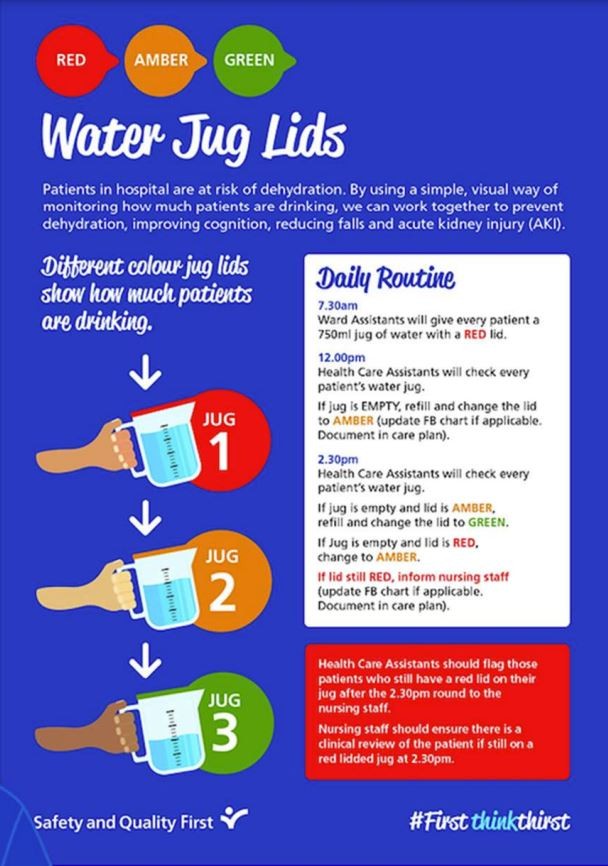
For older patients, the ESPEN 2022 guidelines contain advice on how to promote good hydration in those at risk of low intake dehydration. Measures such as the “Traffic Light” water jug intervention are a ready example of a simple cost-effective risk reduction intervention (as described in a UK Kidney Week 2020 presentation).
Where possible, outside of a resuscitation scenario, fluids should be administered enterally to replenish or maintain adequate requirements. Other routes of administration should only be reserved for circumstances where enteral fluids are not able to be given, they are unable or unlikely to match losses or needs, or where rapid replacement is required.
Assessing the need for IV fluid therapy:
Intravenous fluid should not be a default treatment for all identified AKI given that many AKI syndromes present with fluid overload and IV fluids can worsen or precipitate life threatening complications such as pulmonary oedema. Fluid therapy must be individualised to the situation at hand and this starts with a detailed history and examination as per NICE Guideline 174 – Intravenous Fluid therapy in Adults in Hospital.
NICE prioritises objective bedside observation findings such as low blood pressure, a heart rate >90bpm and a raised NEWS score as being suggestive of hypovolaemia. One of the most suggestive bedside examination features is a postural drop in blood pressure. Examination of the Jugular Venous Pulse is suggested as part of a comprehensive assessment, although clinicians should be aware of the poor sensitivity of the JVP and fluid therapy shouldn’t be guided by JVP assessment alone.
NICE make specific mention of a passive leg raise as a test of fluid responsiveness or demonstrating fluid overload. Details can be found in the assessment section of the guideline.
Fluid Types:
The RCP Acute Care Toolkit – AKI and IV Fluid Therapy contains a nice summary of the options for cystalloid fluid therapy in.
Colloidal fluids (which these days in clinical practice are limited to blood products: human albumin solution and fresh frozen plasma) are generally only used in certain indications and are not generalisable choices for resuscitation, replenishment or routine maintenance.
Resuscitation:
This treatment algorithm is taken from the RCP Toolkit, however it is an analogue of that detailed in NICE Guideline 174. A smaller initial bolus of 250mls can be used where there is particular concern for potential fluid overload.
Choice of Resuscitation Fluid:
There has been a great deal of work looking into the question of whether large volumes of normal saline in a resuscitation setting could potentially be harmful to those with AKI based on theoretical mechanisms that excessive chloride exposure could perpetuate injury or delay recovery. Many (including the 2015 RCP toolkit) have previously advocated for using balanced solutions (Hartmann’s or Lactated Ringer’s) to avoid this possibility.
Thankfully there is some more recent available evidence which has helped clarify matters. The BaSICS trial in 2021 was a large multi-centre randomised control trial found that there was no difference between balanced solutions and normal saline at preventing 90 day mortality in the critically unwell. The FLUID trial from 2025, which again was multi-centre and included over 40,000 individuals, also demonstrated no difference in mortality or 90 day re-admission rates between lactated Ringer’s and normal saline when used hospital wide in a range of presenting conditions and populations (see visual abstract created by the NephJC).
Replacement, Redistribution and Routine Maintenance:
IV fluid algorithms for these situations are available for download from the attached resources to the NICE guidline, here. The RCP Acute Care Toolkit makes fair comment that giving generalisable protocols for standard IV prescriptions in these settings is unhelpful and it is important to assess the individual’s fluid status, biochemistry results and previous and current fluid losses and inputs to offer tailored treatment. As an attempt at a rough estimate for daily fluid requirements by weight, the Toolkit offers this table which is a simplified version of that found in NICE Guideline 174. Maintenance fluid should take into account the need for potassium and other electrolyte replacement as well as typically including an element of glucose replacement to counteract starvation ketosis.
The Toolkit suggests the following rules for prescribing maintenance fluids:
- IV fluid should be given via volumetric pump if a patient is on fluids for over 6 hours or if the fluid contains potassium.
- always prescribe as mL/h, not ‘x hourly’ bags
- never give maintenance fluids at more than 100 mL/h
- never prescribe fluids for more than 24 h at a time.
Reassessment:
The need for IV fluid should be assessed at frequent intervals, whether proactively on at least daily review or reactively to changing physiological or biochemical parameters, or at a change in clinical setting, for instance on arrival to a new ward or after inter-hospital transfer. The establishment and maintenance of the enteral route should be a priority and IV fluids should not be continued longer than necessary.
Fluid Restrictions:
Restricting fluid has previously been a common strategy to help manage fluid overload in settings where fluid intake exceeds output, commonly seen in heart failure. There has been a move away from recommending fluid restriction to all patients with heart failure however, and the latest European Society of Cardiology guidance recommends fluid restriction only in the most severe cases or where hyponatraemia is persistent and problematic. A typical restriction is 1.5-2L/day but in cases of severe hyponatraemia restrictions of 800ml-1L are given as an example. They make specific mention that knowledge regarding the risks and benefits of fluid restriction is a gap in the current evidence base.