

AKI Detection and Alerting
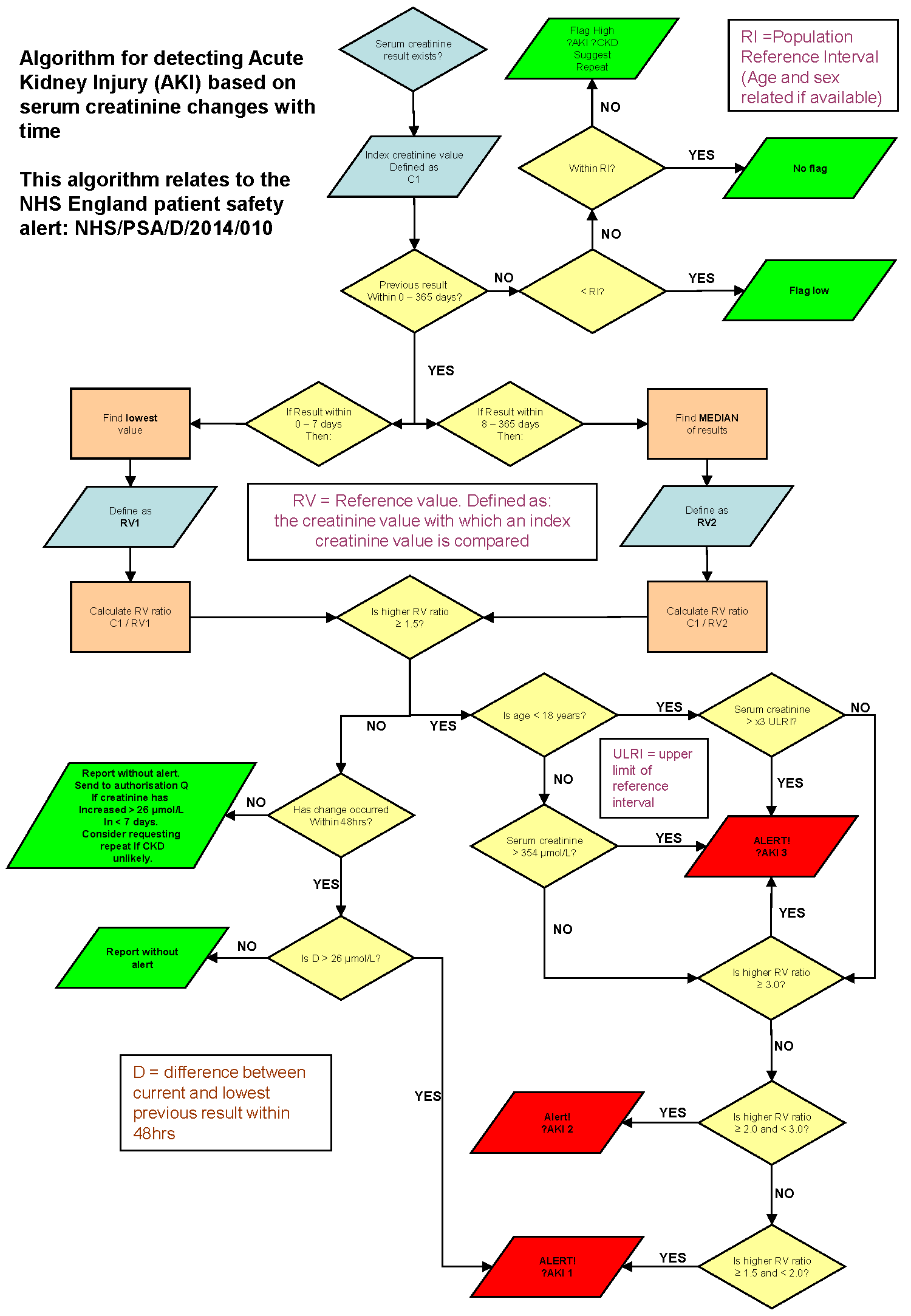
AKI, as defined by the assessment of serum creatinine, is most practically first detected in the laboratory and pathways must be in place to ensure the consistency of reporting along with methods of alerting clinical teams to the presence of an AKI result.
In 2014 NHS England issued a Patient Safety Alert mandating all acute Trusts in England to implement AKI warning stage results and to do so using a standardised algorithm.
Despite this, there remains significant regional variation in laboratory practices when identifying and reporting AKI (1). Laboratories should aim to:
- Use the standardised AKI detection algorithm (see below)
- Assess serum creatinine using an enzymatic assay (as opposed to a Jaffe assay)
- Have a standardised system to flag stage 2 and 3 AKIs to clinical teams – whether by phone call or electronic comment/alert, both in and out of hours.
It should be noted here that estimated glomerular filtration rate (eGFR) calculations and the Kidney Failure Risk Equations are both invalid in the presence of an AKI. Results of which should either be suppressed or reported with comments.
More information regarding the NHS AKI algorithm can be found here: NHS AKI Algorithm
And the flow chart is reproduced below.
- Marrington R, Barton AL, Yates A, McKane W, Selby NM, Murray JS, et al. National recommendations to standardise acute kidney injury detection and alerting. Ann Clin Biochem. 2023;60(6):406–416. DOI:10.1177/00045632231180403.