


AKI vs CKD

Acute kidney injury (AKI) is a sudden decline in kidney function that develops over hours to days, which can disrupt fluid, electrolyte, and acid-base balance.

It is important to distinguish AKI from CKD, as AKI develops rapidly and is often reversible, whereas CKD is a long-term condition that persists for more than 3 months. The table below summarises the key differences between CKD and AKI.

CKD AKI
Onset Gradual (>3 months) Sudden (days)
Reversibility Usually progressive, not reversible Often reversible
eGFR Trend Stable or slowly declining (typically) Rapid decline
Urine Output Often normal until advanced May be acutely reduced

Suspect AKI over CKD if an initial eGFR is lower than expected for the patient’s history or presentation. Don’t assume CKD or AKI from a single low reading. AKI is common in acutely unwell patients, e.g. with dehydration, hypotension, sepsis, or intercurrent illness. Follow-up eGFR is essential to determine whether it was AKI, CKD, or AKI on CKD.

warning icon

AKI and CKD are closely linked: AKI can lead to CKD, and CKD increases the risk of AKI.

Patients recovering from AKI should have their CKD medications reviewed. RAS inhibitors (ACE inhibitors or ARBs) and SGLT2 inhibitors are often temporarily withheld during acute illness but should usually be restarted once the patient has recovered, unless a new contraindication has arisen. These treatments are NOT nephrotoxic and provide important kidney and cardiovascular protection.

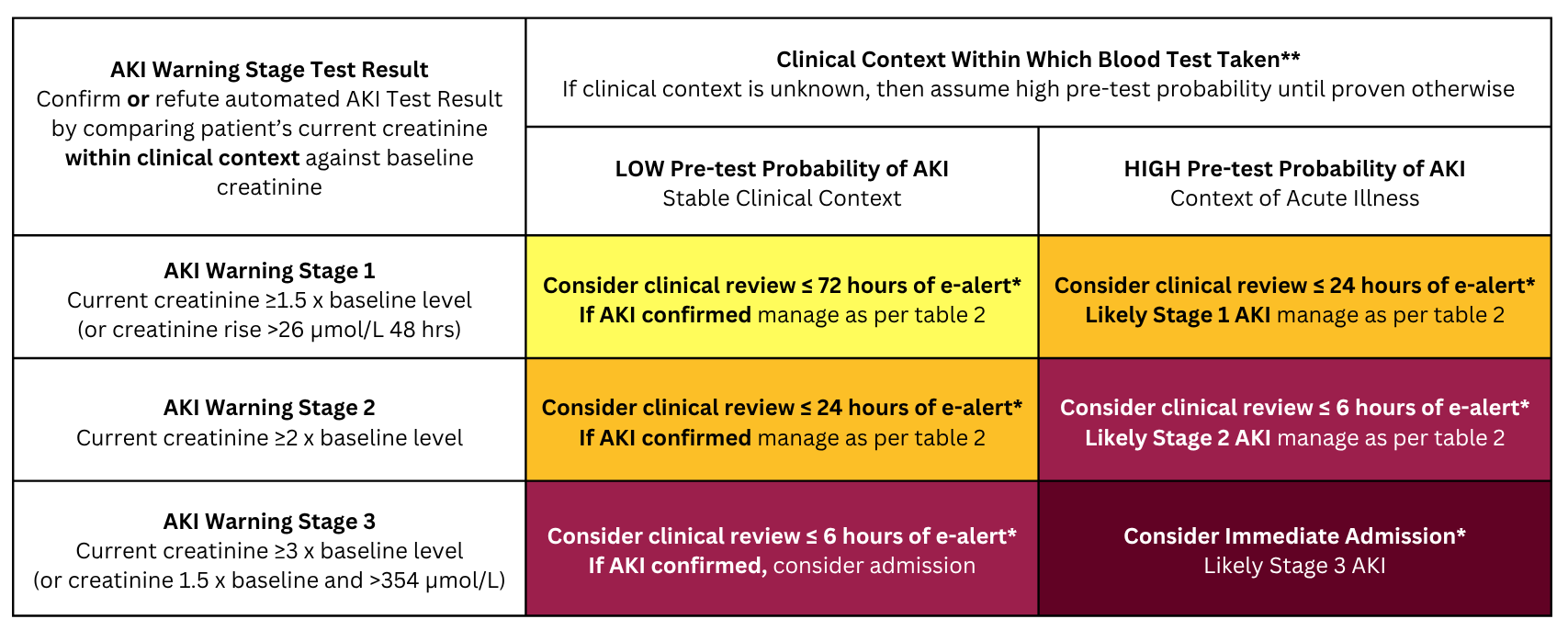
AKI stages and recommended response times to AKI warning test stage results for adults in primary care

AKI stage Creatinine Urine output
1 Serum creatinine 1.5–1.9 × baseline or ≥26 μmol/L (≥0.3 mg/dL) <0.5 mL/kg/hour for 6–12 hours
2 Creatinine 2.0–2.9 × baseline <0.5 mL/kg/hour for ≥12 hours
3 Creatinine ≥3.0 × baseline or ≥354 μmol/L (≥4.0 mg/dL) or initiation of kidney replacement therapy <0.3 mL/kg/hour for ≥24 hours or anuria for ≥12 hours

Clinical context

Why was the blood test taken?

  • Routine chronic disease monitoring
  • Drug monitoring
  • Assessment of acute illness

Creatinine rise within stable clinical context may reflect unstable CKD instead of AKI, especially if longer time period between current and baseline creatinine.

AKI risk factors/clinical features prompting earlier review

  • Poor oral intake/urine output
  • Evidence of hyperkalaemia, especially if moderate(K+ 6.0-6.4) or severe (K+ ≥ 6.5) *
  • Known history of CKD stages 4 & 5 or history of kidney transplant
  • Deficient Immunity
  • Frail with co-morbidities (CKD, diabetes, heart failure, liver disease, neurological or cognitive impairment)
  • Past history of AKI
  • Suspected intrinsic kidney disease
  • Suspected urinary tract obstruction

* UK Kidney Association Clinical Practice Guidelines (2023) recommend emergency assessment and treatment of severe hyperkalaemia (K+≥6.5mmol/l)

AKI Guide

For more information about AKI diagnosis, staging, and management, see the UKKA AKI Guide.