

Coding and risk stratification
Classifying and coding CKD
CKD is classified, staged, and coded according to persistent uACR and eGFR results. The flowchart below outlines when uACR and eGFR testing should be repeated and when CKD should be coded based on these measurements.
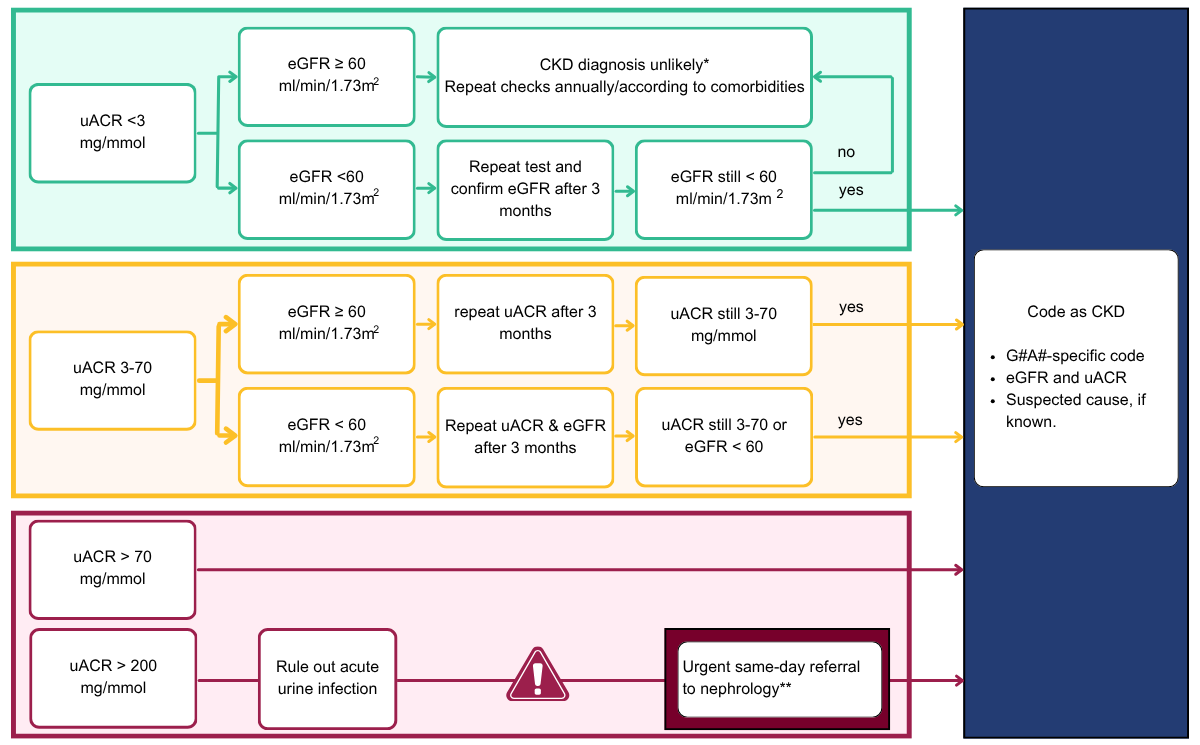
* A person may still have CKD if they have other markers of kidney disease. See G1A1 and G2A1 box, below.
** See referral section for additional criteria.
The G#A# Classification
The KDIGO heatmap (below) combines eGFR and uACR categories into a G#A# classification that reflects the risk of adverse outcomes, including cardiovascular events, CKD progression, and AKI. Higher G and/or A categories are associated with greater risk and therefore warrant more frequent monitoring, as shown in the testing recommendations.
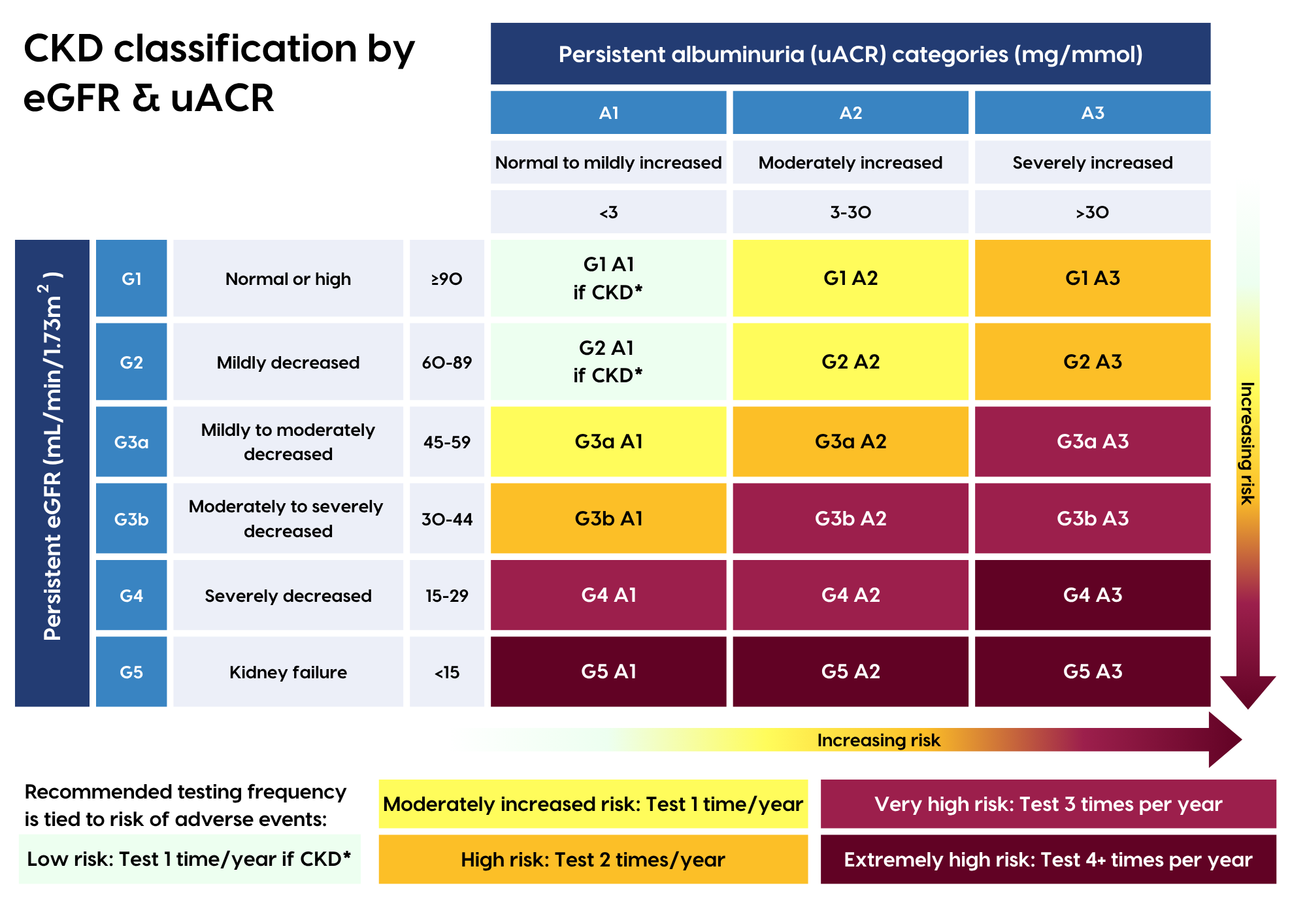
* Only CKD if other markers of kidney disease are present, see G1A1/G2A1 box, above.
Adapted with permission from Kidney Disease: Improving Global Outcomes (KDIGO) CKD Work Group (2013) KDIGO 2012 clinical practice guideline for the evaluation and management of chronic kidney disease. Kidney International (Suppl. 3): 1-150.

G1A1 & G2A1
CKD may still be present even if uACR and eGFR are normal when other markers of kidney disease are present, including:
- urine sediment abnormalities
- electrolyte and other abnormalities due to tubular disorders
- abnormalities detected by histology
- structural abnormalities detected by imaging
- history of kidney transplantation
In these cases, people with a normal eGFR are classified as having G1A1 or G2A1 CKD.
If none of these markers are present and uACR < 3 mg/mmol & eGFR ≥ 60 ml/min/1.73m² → not CKD.
Discussing diagnosis and cause
Agree a plan to establish cause of CKD during an informed discussion with the person diagnosed with CKD, especially if it may be treatable. Discuss risk factors with the person using the eGFR and ACR categories, including risk of progression using the kidney failure risk equation.
See section on talking to people about their CKD diagnosis for simple language that can be used and patient-facing resources to complement your discussion.
Best Practice for coding
✅ Use stage-specific SNOMED codes (e.g. “CKD G3aA2”, see image above) rather than a generic “CKD” code. This supports accurate case-finding, monitoring recalls, and KFRE calculation.
✅ Record both eGFR and ACR in structured fields and update the stage if these values change over time.
✅ Code the underlying cause where known (e.g. diabetes, hypertension, structural renal tract disease, multisystem disease affecting kidneys, hereditary kidney disease — see the list of risk factors in the “who to test” section or NICE NG 203).